
Mothers Recharge: Motherhood and the Sauna
One Thursday morning, after dropping my daughter at nursery, I realised how depleted I already felt. The day had barely begun, yet my shoulders were tight and my mind crowded. Maybe it was the 3am toilet-training wake-up. Maybe it was the quiet marathon of getting a toddler out of the house before 9am, with all the tiny negotiations that requires.
Whatever the cause, I felt a deep sense of relief knowing that in a few hours I would be at Mothers Recharge, a weekly, women-only (should we say mums-only to avoid problems?) community sauna session I founded in 2025 with London’s Community Sauna Baths, offering uninterrupted time to recover.
Motherhood is ongoing labour. It rarely pauses and is seldom recognised as work that requires recovery. Yet if motherhood is labour, then rest cannot be an occasional reward. It must be a basic and necessary condition, something that makes care sustainable in the first place.
This is where sauna enters the picture, not as a luxury add-on, but as a practical, communal tool for nervous system repair. Heat, cold, stillness, and shared quiet create conditions where the body can shift out of constant vigilance and into restoration. For people who are needed all the time, that shift is profound.
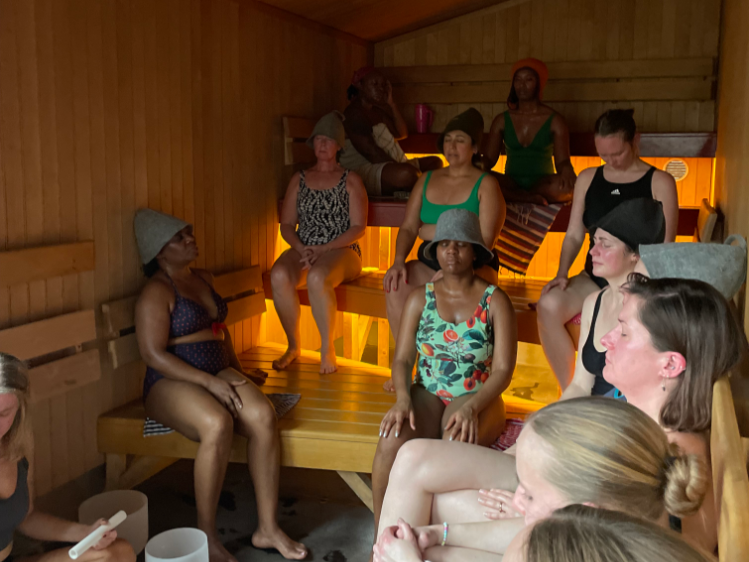
Image: A Mothers Recharge session at Community Sauna Baths, Camberwell site.
At Mothers Recharge, rest isn’t a bonus. It’s the whole point. The sessions run as a Thursday drop-in, offering quiet, unstructured time to move between heat, cool air, and stillness without expectation. There’s no programme to follow and nothing to achieve. Just 90 minutes to sit, sweat, breathe, and exist alongside other women who understand what it means to be needed constantly.
For many, this is their first experience of sauna outside a spa setting. Instead of performance or pampering, they find something older and simpler: shared heat, shared silence, shared presence. What started as a small gathering has grown. Women come not only for the physical effects of heat, but to connect and reset, rediscovering wellbeing as something communal rather than individual.
One mother told me: “I wish we’d had something like this when my children were young. They’re all grown now. Early motherhood was rough for me. My family lived far away, and I didn’t know what I was doing. A space like this would have been lovely to have.”
Comments like this reveal just how quietly radical spaces like Mothers Recharge can be. In a culture where so much of child-rearing happens behind closed doors, care is treated as a private responsibility. Rest, too, becomes a private problem to solve, squeezed into spare minutes or postponed indefinitely.
But when rest is held collectively, something shifts. It stops being indulgence and starts to look like shared infrastructure. Insisting that mothers deserve rest is about recognising that communities function only when the people doing the caring are supported too.

Image: Harieth enjoying a Mothers Recharge session at Community Sauna Baths, Camberwell site.
I started Mothers Recharge shortly after Community Sauna Baths opened its Camberwell site. The intention was to make the sauna feel like a doorway more mothers could comfortably walk through. While the original aim was to welcome more Black mothers into sauna spaces where they’ve historically been underrepresented, the sessions have grown into a diverse and evolving community. Around 20 mothers now attend each week, travelling from across London and sometimes further afield. We’ve welcomed mothers from Manchester, Sussex, and even visitors from the United States. A visitor from North Dakota said: “Those who can afford it have saunas in their homes, but it’s not the same. It’s nice to do something like this together as women.”
The group includes a company director balancing a high-pressure role while parenting an energetic toddler, alongside a 21-year-old mother of a four-year-old who is keen to learn from the older women. Another woman, who recently lost her partner, comes to combat her grief; ’My partner was a soulmate his absence has been agony, emotional torture. Not only is my heart broken but the grief can make me feel physically ill; it strips me of my joy, of who I am. That first visit, after warming my body in the sauna, I sat in the cold plunge pool and stared at the sky {…} When I left the sauna that day I felt the most alive I had felt in weeks. I now attend Mother's Recharge religiously every week to give my nervous system a helping hand while it grapples with grief, it feels like an essential medicine for this challenge.’
The sessions are still predominantly white, with around 20 percent Black mothers, but the intention to broaden access remains central. What connects everyone is shared tiredness, and the sauna has become a point of connection beyond the sessions themselves. Mothers who first met on the benches now meet for coffee, walk the school run together, or arrange playdates. Some return weekly, picking up conversations where they left off. The rhythm of the space offers continuity in lives that often feel fragmented. As one regular put it: “I get excited knowing I’ll see familiar faces. It feels like I’m with my sisters.”
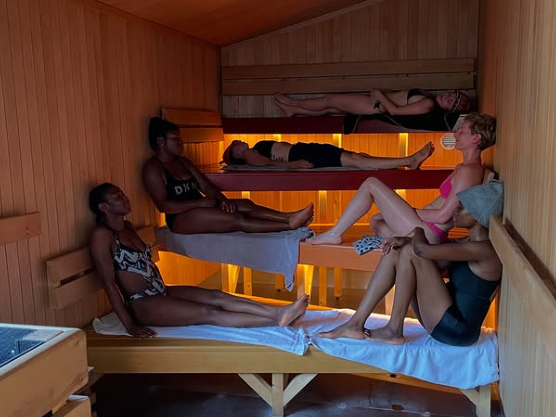
Image: A Mothers Recharge session at Community Sauna Baths, Camberwell site.
As the community has grown, so has awareness that childcare remains a real barrier. Time alone is not easy to come by when you’re responsible for small children. Community Sauna Baths has shown real commitment to reducing that barrier. At the Hackney Wick site, its Mama Swim sessions allow mothers to sauna and plunge while taking part in a crèche-style babysitting exchange, so everyone gets a chance to rest knowing their children are safe.
At the Camberwell site, subsidised sessions help make Mothers Recharge financially accessible, and timings during school hours support mothers with older children. For mums with newborns, a newly erected yurt offers a warm, dry space for babies, making shared childcare during sessions more manageable. Mums leave feeling steadier, more resourced, and better able to meet the demands waiting for them at home. Friendships form. Childcare is exchanged. Conversations continue in a shared WhatsApp group between sessions. Support stretches beyond the sauna walls. The Thursday sessions have been so successful that we are discussing a monthly Sunday session from April 2026, to include working mothers and those unable to attend during the week.
Mothers Recharge points toward a different way of organising support, one that sauna is uniquely placed to offer. What began as a small invitation into rest is slowly becoming a solid example of what maternal support can look like when this rest is treated as essential rather than earned. I’ve received messages from mothers inspired to approach their own local saunas to set up parent-friendly sessions. And change happens by mothers asking to be included and by operators considering design, access, pricing, timing, and culture with carers in mind.
My hope is that this is only the beginning, that one day sessions like this will be commonplace, and that sauna spaces across the UK will recognise mothers and carers not as an afterthought, but as central to the communities they serve.