From kiki to bouba: what sauna does to the body that words can't say.
I handed eighteen sauna bathers paper and pens in the moments after an Aufguss ritual, and asked them to draw how they felt.
They had minimal prompts to guide them: where do you feel warmth? What does your mind feel like right now?, but the drawings they made were entirely their own. Large A1 sheets of paper. Coloured pens and pencils. Bodies still steaming, breath still settling.
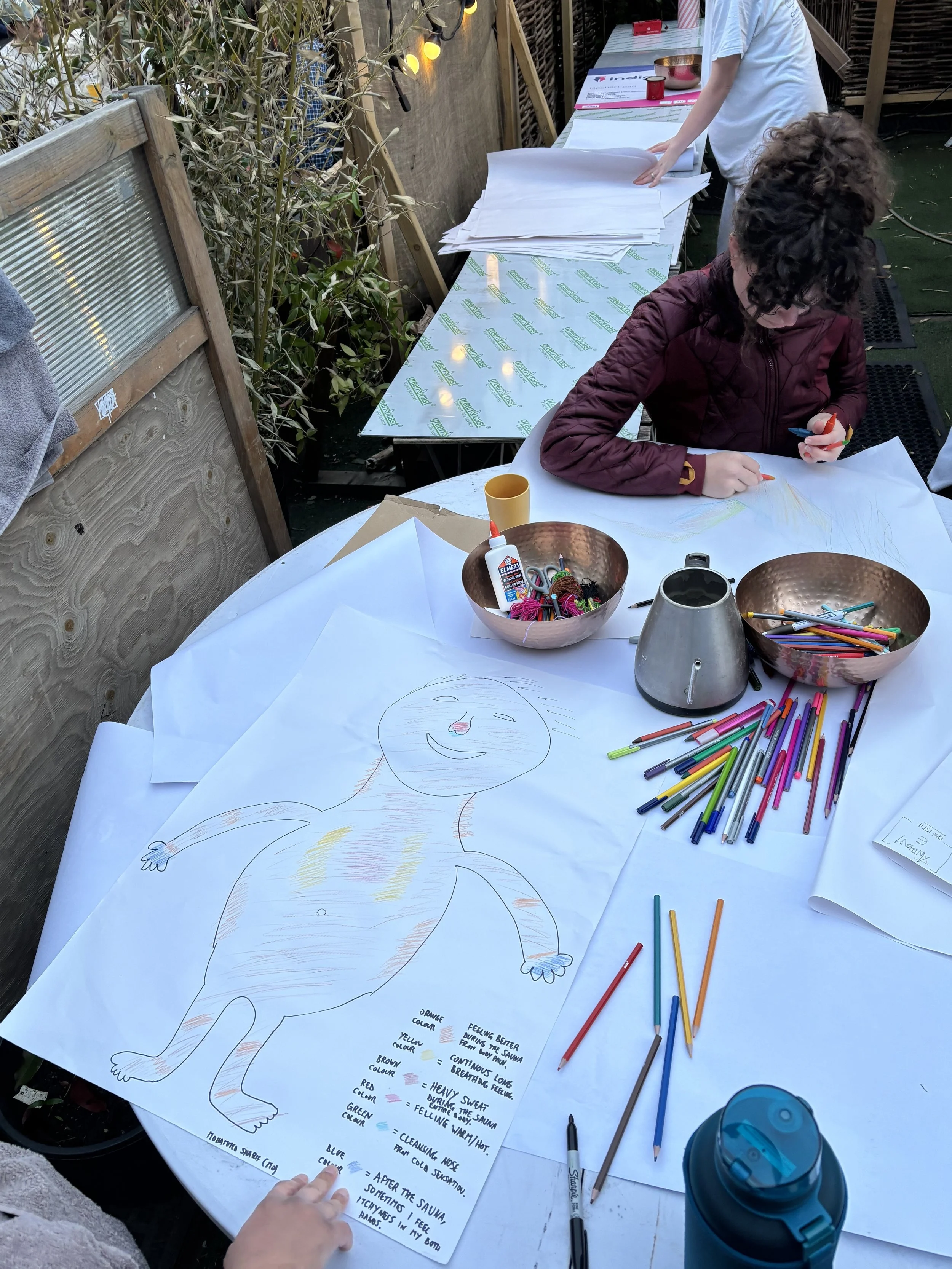
The drawing session held after an Aufguss ritual.
What they drew, independently, without seeing each other's work, was remarkably similar. Spirals, again and again, as symbols of transformation. Yellow and orange halos radiating from the head. Soft, rounded figures. Arrows flowing upward. And scattered across the maps, in their own handwriting: “light and floaty”. “Ease flowing through my limbs”. “ Overwhelm turned to trust, and dread into clarity”.
One map caught my attention. A participant had drawn themselves twice, before and after the ritual, without being explicitly asked to. The before-body was angular and spiky, crossed through with urgent red marks. The after-body was round, soft, glowing at its edges, surrounded by a yellow halo. Without knowing it, they had illustrated one of the most compelling phenomena in sensory psychology: the bouba-kiki effect, first described by Wolfgang Köhler and more recently examined by Passi and Arun (2022), which captures our deep, cross-cultural tendency to associate rounded shapes with softness and angular shapes with tension. The sauna had moved this person from kiki to bouba.
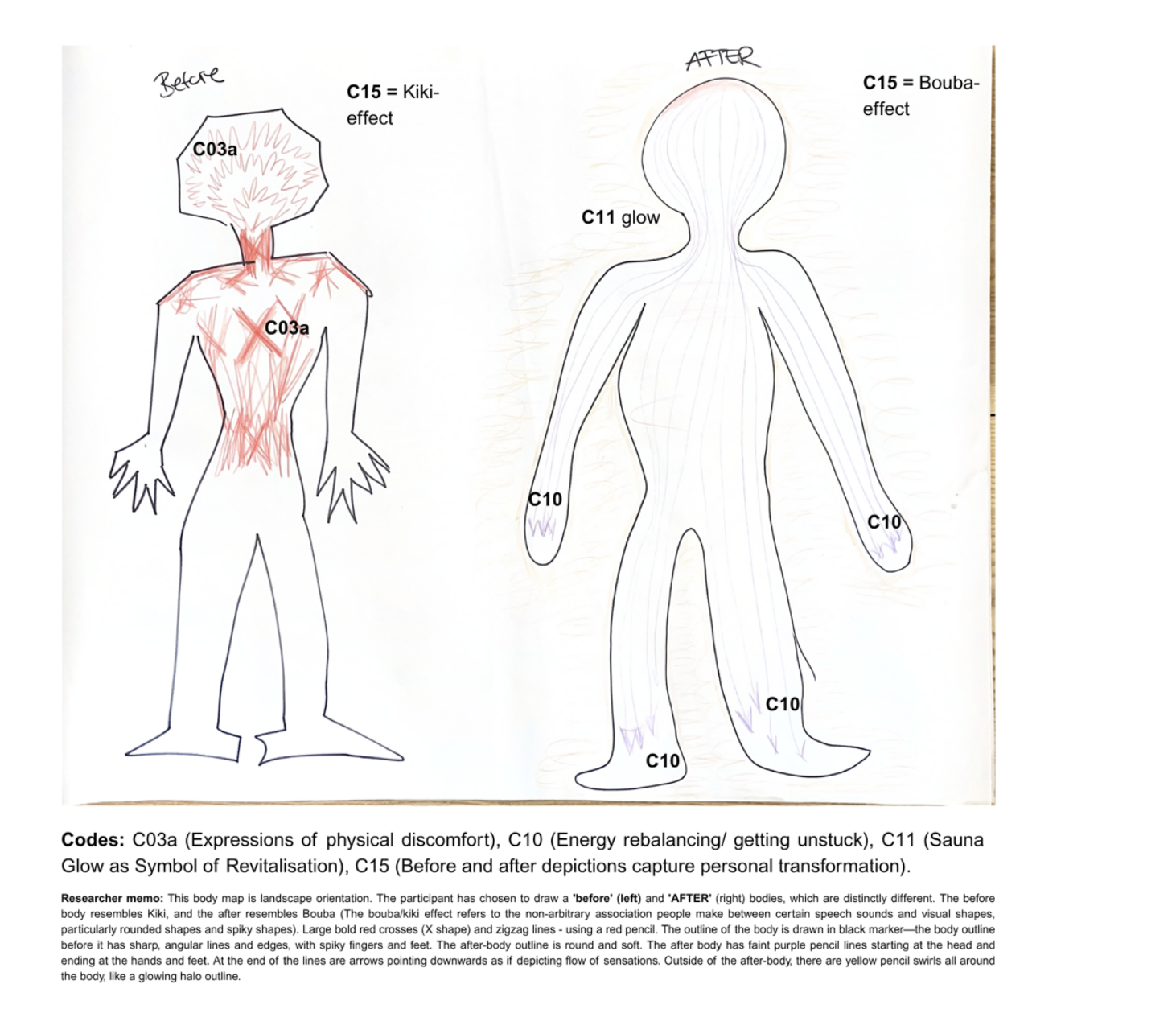
The kiki-bouba map drawn by a participant: before and after.
This was the first known use of body mapping, an ethnographic method developed to help people reflect on lived, traumatic experiences (University of Denver, 2020), in a sauna context. I ran the session at Hackney Wick Baths as part of my dissertation research, asking whether saunas should be prescribed on the NHS. The body maps were one strand of that inquiry. I wanted to know what ritual does to us that we can't articulate. Researchers call this tacit knowledge, the knowing that lives in the body rather than the mind.
What I found is that the Aufguss ritual creates the conditions for something profound. The sauna master's art, the sequencing of heat, breath, scent and sound; the reading of the room; the choreography of the towel, is a mechanism for invoking transformative experiences. It invites bathers to drop out of the thinking mind and back into the sensing body. And when that happens, people reach, instinctively, for the same visual symbols to describe their experience.
It suggests something shared is occurring, not just relaxation, but a kind of emotional synchrony.
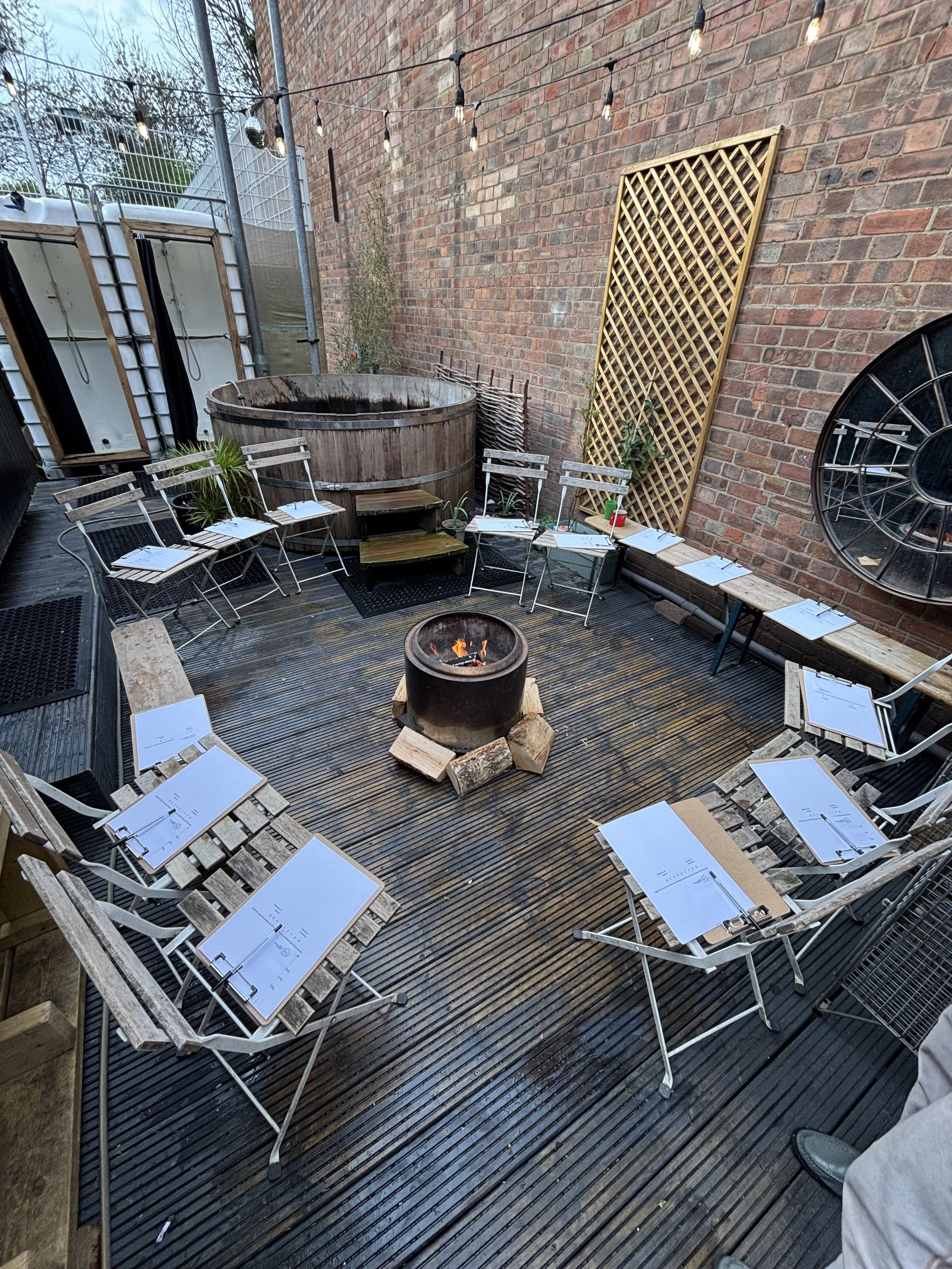
Thermal drawing session held at Hackney Wick Baths.
My own published research, conducted with colleagues at the University of Greenwich and recently published in Social Science & Medicine, found across three studies and nearly 2,000 participants that emotional synchrony and ritual are the very mechanisms through which sauna builds belonging — and through belonging, measurable improvements in both physical and mental wellbeing (Newson et al., 2026). The body maps, drawn in silence and independently, are a visual record of exactly that process. The room becomes a collective experience, and the body maps are its record.
Professor Daisy Fancourt has spent her career making the case that art is medicine. Her research, and her recent book, The Art Cure, argues that creative engagement actively supports health, and that art interventions belong in the clinical toolkit alongside more conventional treatments. In England, this thinking has begun to shape NHS social prescribing frameworks, where GPs can now refer patients to community and cultural activities as part of their care.
I want to make a case that Aufguss belongs in that conversation.
If art heals in part by giving form to feelings that resist language, and Fancourt's evidence suggests it does, then the combination of an Aufguss ritual followed by body mapping is a particularly potent pairing. The ritual creates the embodied state. The body map makes it visible, legible, and real. Together, they do something that neither does alone: they move an experience from the body onto the page, where it can be witnessed, and perhaps released.
One participant wrote, in the quiet after their session: “I started feeling tired and stressed from the week. The heat, smells, sounds, breathing and energy of the space really helped me melt away my stress, replacing it with this beautiful calm feeling, which I've expressed here by using a mix of soft colours”.
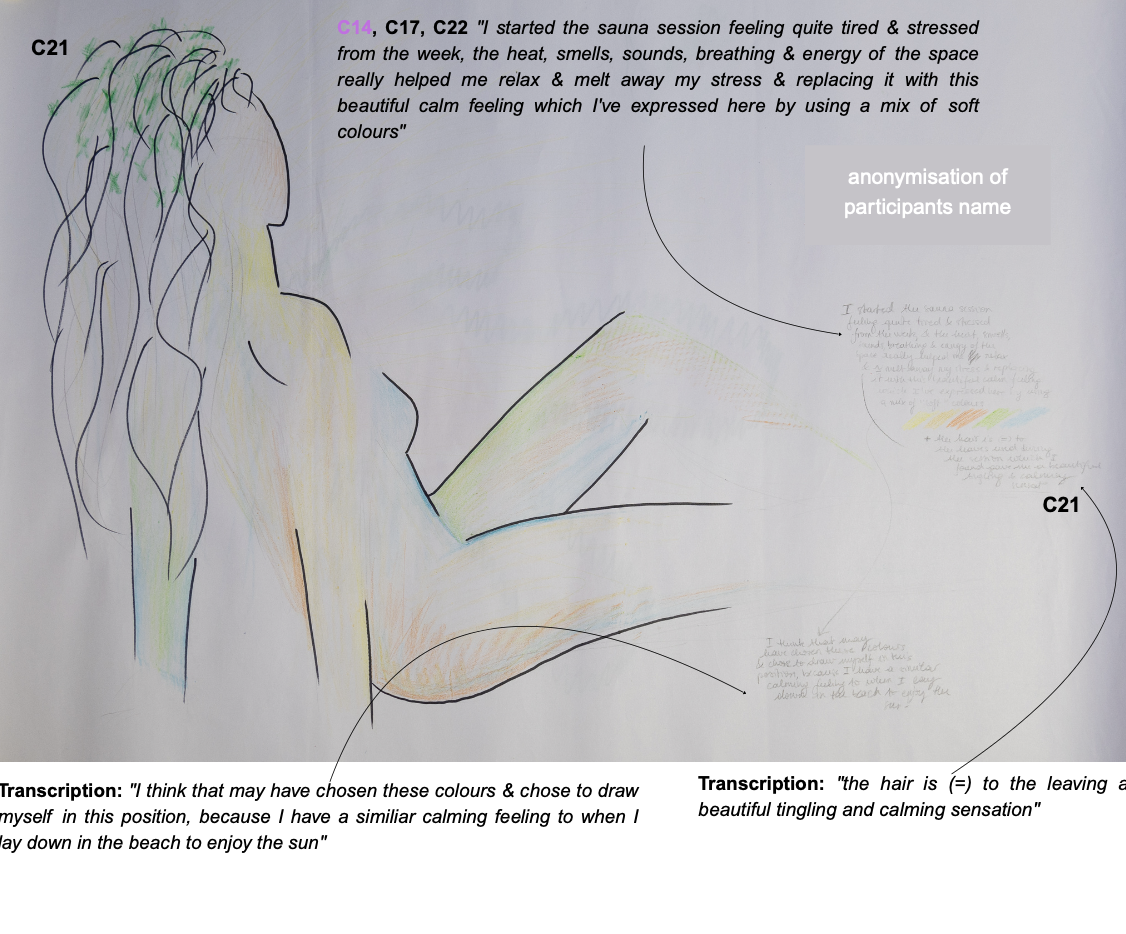
Participant drawn image of the pastel coloured woman.
That is a real sauna bather, sitting quietly after a ritual, reaching for words and colours to describe something that had been living in her body all week without a name.
Fancourt's argument is that art heals because it gives form to what we cannot otherwise express. The body maps are proof of that, drawn in real time, by real people, in the afterglow of ritual. Angular bodies made soft. Crossed-out tension replaced by golden halos. Kiki, becoming bouba. If that isn't the art cure made visible, I don't know what is. A GP prescription for an Aufguss and a 30-minutes to draw your body, suddenly, less like a radical idea and more like an overdue one.
I'm still working out the best way to share these unseen findings, the full body map database, all 18 participant maps, the codebook, and researcher memos, with the world. If you have an idea of where they belong, or you're a researcher, practitioner, or operator interested in sauna body mapping or the thermal circle methodology behind this work, I'd love to hear from you.
Feel free to reach out on rachael.mcgrath@lis.ac.uk.
The author's dissertation research, 'Should Saunas Be Prescribed?', was conducted at Hackney Wick Baths. The body map database, including all 18 participant maps and the full codebook, forms part of that unpublished research.
Further reading & References
On the art cure Fancourt, D. (2026). Art Cure: The Science of How the Arts Transform Our Health. Cornerstone Press.https://www.penguin.co.uk/books/462340/art-cure-by-fancourt-daisy/9781529935530
On body mapping, and expressive arts as healing Malchiodi, C. A. (2020). Trauma and expressive arts therapy: Brain, body, and imagination in the healing process. The Guilford Press. University of Denver. (2020). Body Mapping Resource Page.https://www.du.edu/4D-experience/resources/body-mapping
On emotional synchrony, ritual, and sauna wellbeingNewson et al. (2026). Sauna culture improves physical and mental wellbeing in the UK. Social Science & Medicine.https://doi.org/10.1016/j.socscimed.2026.119061
On the bouba-kiki effectPassi, A., & Arun, S. P. (2022). The Bouba–Kiki effect is predicted by sound properties but not speech properties. Attention, Perception, & Psychophysics.https://doi.org/10.3758/s13414-022-02619-8
On social prescribing Bickerdike, L. et al. (2017). Social prescribing: less rhetoric and more reality. BMJ Open.https://bmjopen.bmj.com/content/7/4/e013384.abstract NHS England. (2025).
On sauna and mental/physical healthLaukkanen, J. A. et al. (2018). Cardiovascular and other health benefits of sauna bathing. Mayo Clinic Proceedings.https://doi.org/10.1016/j.mayocp.2018.04.008