
Sauna Summit 2026: What Will British Sauna Look Like in 2030?
On 1 June, the British sauna community gathered at Brighton Dome for Sauna Summit 2026. A day of keynotes, panels, and conversation shaped around one central question: what will British sauna look like in 2030?
It was a question that hung in the air from the opening session and one that - by the end of the day - felt less like a question and more like an invitation.
There's something fitting about returning to Brighton. The morning opened with an origin story. A look back at how this city became the birthplace of the modern UK sauna movement, what started as an art project in the early days, through the work of Bethany Wells from Warmth Community Sauna, Liz Watson from Beach Box Spa, and Katie Bracher from Wild Spa Wowo, who had an idea to bring a horse box sauna to Brighton beach. From those early, wind-battered beginnings on the seafront, to a packed summit at one of Brighton's most beautiful venues, the arc of the last few years was impossible to ignore.
Brighton Dome itself set the tone, the elegant arches of its ceiling, the light through its distinctive windows, a space that felt worthy of the conversations happening inside it. And just a short walk away, the beach was already waiting.
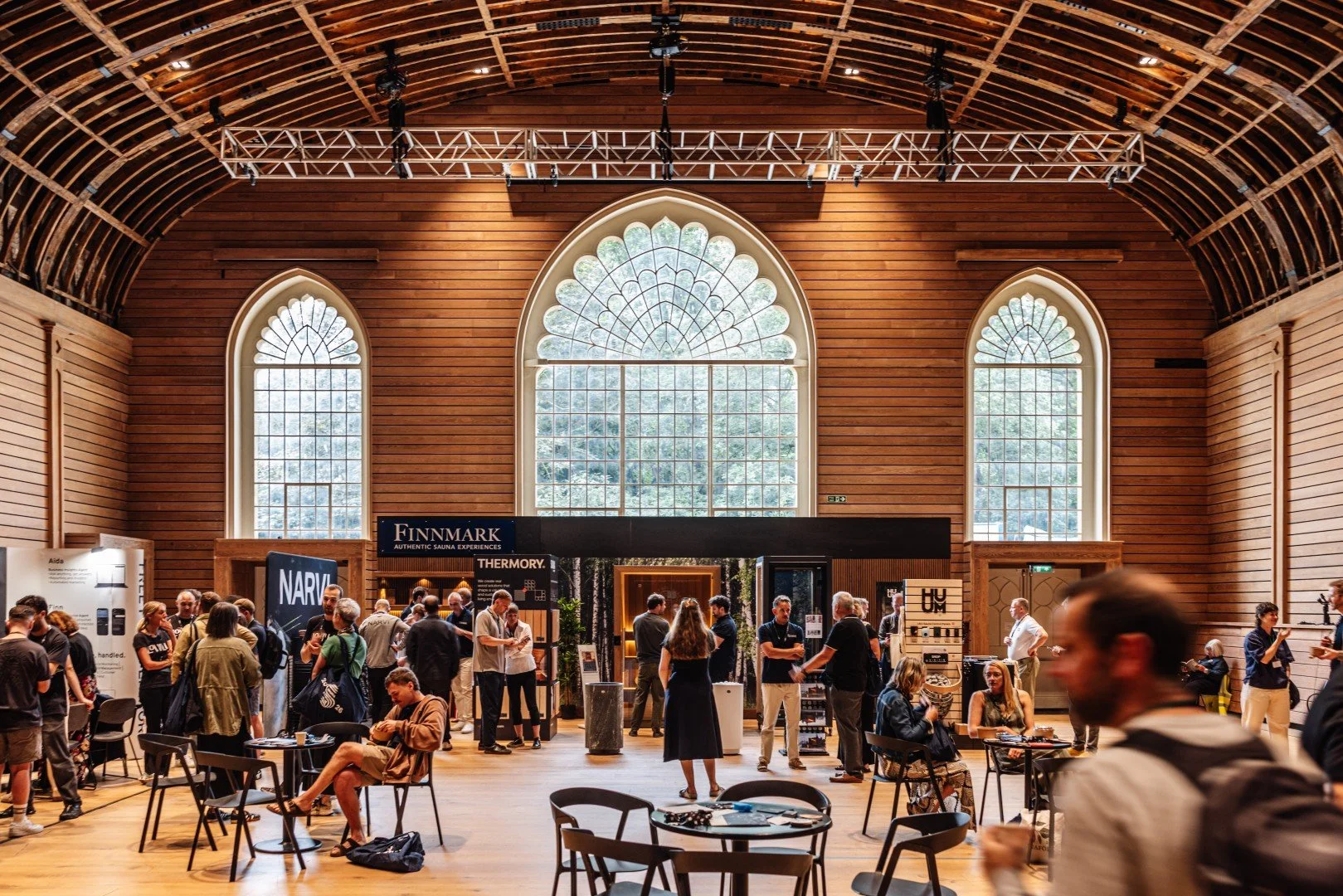
The exhibition hall at Sauna Summit 2026. Photograph by Joe Lang.
The morning opened with welcome remarks and a fireside chat with Teemu Turunen, the Finnish Ambassador to the United Kingdom, a reminder, right from the off, that what we're building here has roots that run deep, and that the wider world is watching with interest.
Then came the question that shaped the rest of the day. What will sauna look like in 2030? Professor David Russell, CEO of Therme UK, opened with an answer that was big in vision: large-scale, architect-designed thermal destinations are coming to the UK, with Manchester leading the way.
Lucy Osborne of Studio 360 took us to Edinburgh - where they are bringing large-format, seated sauna experiences into the heart of the Fringe Festival. Blending theatre, the arts and comedy with heat. It's the kind of idea that makes you wonder what else is possible, and who else we might reach when we start to see sauna as a canvas.
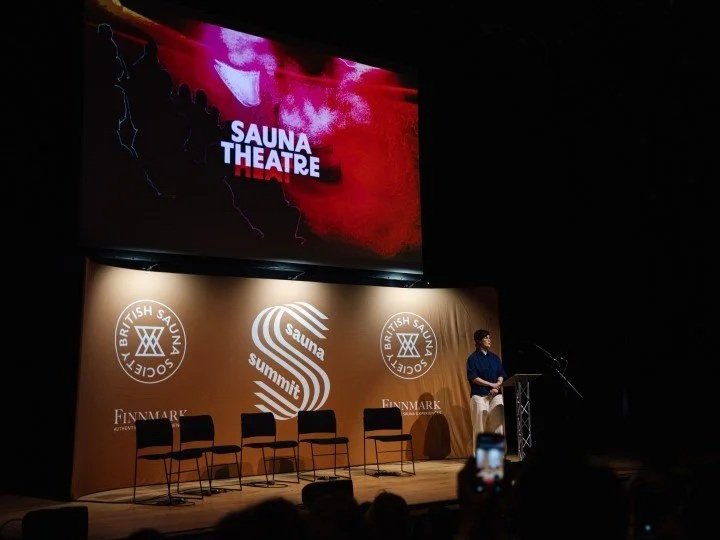
Lucy Osborne on the main stage at Sauna Summit talking about Sauna Theatre.
The panel that followed — with Professor Russell, Lucy Osborne, Olly Davey of Heartwood Sauna, and Jake Newport of Finnmark, moderated by Don Genders — gave the room space to sit with these questions. And it was Jake who offered perhaps the most useful frame for independent operators navigating what's ahead. "What do you get from the bakers that you don't get from your trip to Tesco?" he asked. The UK sauna market is nowhere near saturation. The answer isn't to compete on price. It's to lean into what makes your experience irreplaceable - your expression of the craft, the ritual, the human connection, the things that make it unique to you.
Author Bill Gifford — whose new book Hotwired explores the science of heat and human resilience — delivered what was widely regarded as a highlight of the day. In conversation with Emma O'Kelly, author of Sauna: The Power of Deep Heat, he brought both rigour and warmth to the case for heat as a profound tool for health. The kind of session that leaves you with not just new information, but a renewed sense of why this all matters.
Adam Bamba Tanaka, COO of Therme Group US, spoke to the new culture of bathing — and in particular, how the arts are finding their way into thermal spaces as a form of expression. And Norwegian architect Sami Rintala brought a portfolio of projects that showed what happens when sauna becomes architecture, becomes landscape, becomes something you could only find in one particular place on earth.
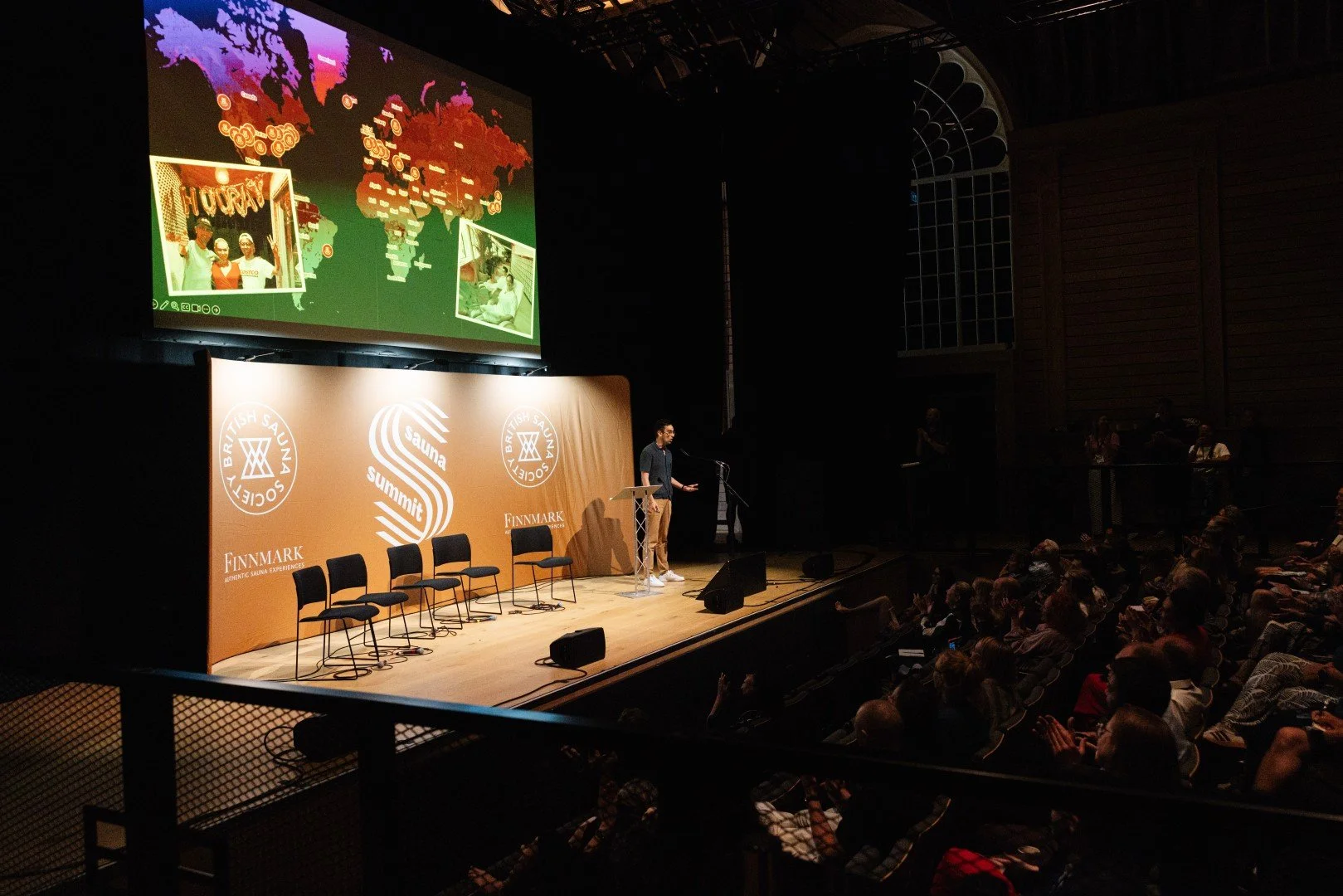
Adam Bamba Tanaka on the main stage talking about The Culture of Bathing.
By the time lunch arrived, the morning had made its case: sauna in the UK is not one thing. It is operators, architects, performers, artists, and academics, from horse boxes on the beach to big theatres. And we're only just getting started.
The afternoon broke into parallel sessions, and this felt like one of the most significant evolutions of Summit yet. You could choose between conversations on sauna's role in mental health, widening access through the health system, professional standards and skills, and lessons from fast-growth operators. A recognition that the community now contains multitudes, and that different people need different conversations happening.
What ran through all of it was something harder to programme: a genuine openness about what people have learned, what has been hard, and where we still need to grow.
If the day inside Brighton Dome asked the big questions, the evening on the beach answered them.
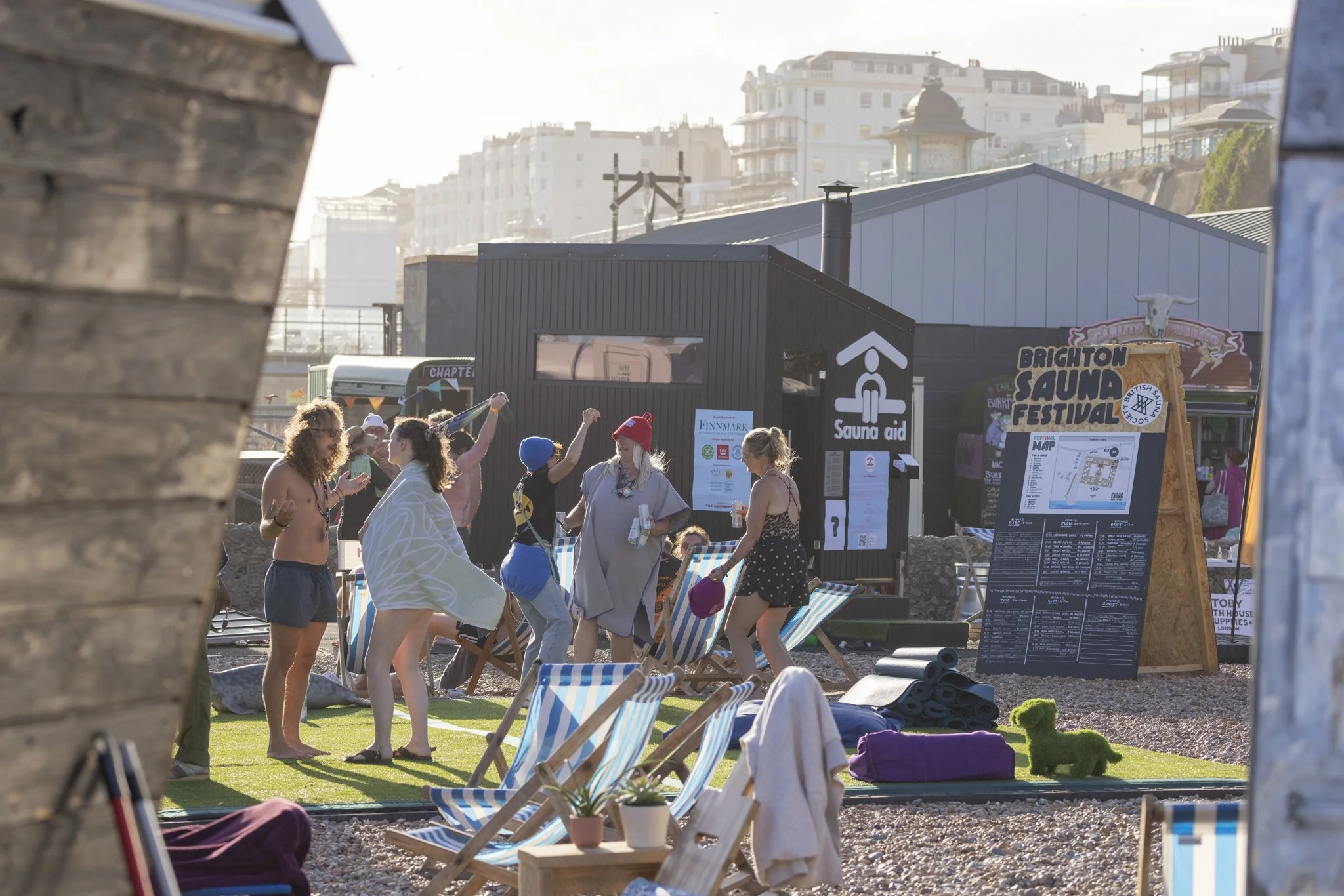
The evening of Sauna Summit 2026 on the beach in Brighton.
More than twenty saunas lined the seafront, each one different. Different designs, different rituals, different hosts, different atmospheres. Some intimate, some theatrical, some meditative. Moving freely between them, it was easy to see what our UK sauna culture has become, it’s a unique form of creative expression. A way for individuals to build communities through heat, rest and togetherness in a way that feels true to them.
Standing on Brighton beach that evening, surrounded by twenty entirely distinct interpretations of the same ancient practice, one thing felt obvious: the perfect sauna isn't a fixed thing. It's whatever feels true to the person who builds it, the person that hosts it, and the people who gather inside it.
Sauna Summit isn't there to resolve all the questions, but to gather the people who are shaping the answers and to remind us how far we've already come. From a handful of pioneers on Brighton beach to a full day of keynotes, researchers, architects, and operators, this is a movement that is only getting started.
